Runners, Riders, and this time, Formulae!
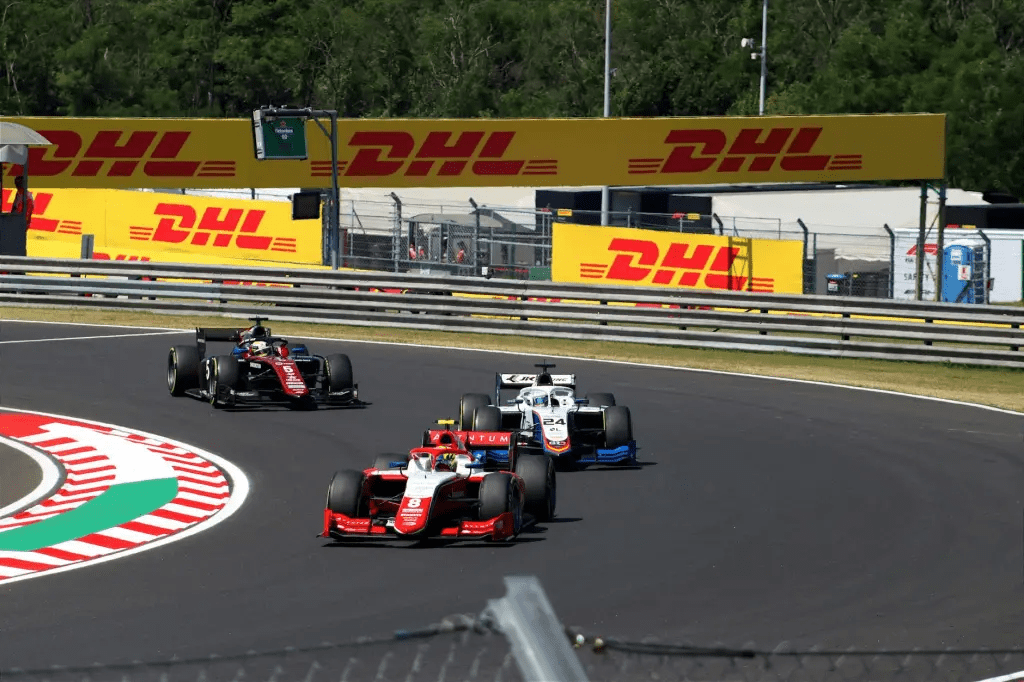
Much as I said in the intro to my F3 Preview, the season for the FIA’s three global championships is upon us, and as I’m much more a fan of the two nominally less important ones, I thought I’d write some previews and leave F1 for people who think things like “audience” are important factors for your blog.
Who’s Driving In This One, Then?
F2 is now the exact same size as F1 – eleven two-car teams for 22 drivers. Somehow, they frequently seem more prone to chaos than F3’s ten three-car teams, despite both being more experienced and there being fewer of them. Here’s who they are:
| Driver | # | Team | What they did last year |
|---|---|---|---|
| Rafael Camara | 1 | Invicta | Champion, F3 |
| Joshua Durksen | 2 | Invicta | 9th in F2 |
| Ritomo Miyata | 3 | Hitech | 17th in F2 |
| Colton Herta | 4 | Hitech | 7th in IndyCar |
| Noel León | 5 | Campos | 17th in F3 |
| Nikola Tsolov | 6 | Campos | 2nd in F3 |
| Dino Beganovic | 7 | DAMS | 7th in F2 |
| Roman Bilinski | 8 | DAMS | 11th in F3 |
| Gabriele Mini | 9 | MP | 13th in F2 |
| Oliver Goethe | 10 | MP | 15th in F2 |
| Sebastián Montoya | 11 | Prema | 12th in F2 |
| Mari Boya | 12 | Prema | 3rd in F3 |
| Martinius Stenshorne | 14 | Rodin | 5th in F3 |
| Alex Dunne | 15 | Rodin | 5th in F2 |
| Kush Maini | 16 | ART | 16th in F2 |
| Tasanapol Inthraphuvasak | 17 | ART | 7th in F3 |
| Emerson Fittipaldi Jr | 20 | AIX | 11th in Eurocup-3 |
| Cian Shields | 21 | AIX | 24th in F2 |
| Nicolás Varrone | 22 | Van Amersfoort | 27th in WEC Hypercar |
| Rafael Villagómez | 23 | Van Amersfoort | 14th in F2 |
| Laurens van Hoepen | 24 | Trident | 12th in F3 |
| John Bennett | 25 | Trident | 22nd in F2 |
It’s probably less necessary of me to explain what all of the series are this time, but just to be sure I’ll do it anyway.
F2: the series they’re all in this year. The FIA’s international second-tier series, designed to prepare drivers for F1.
F3: The FIA’s international third-tier series, and generally considered the strongest third-tier series, particularly if you intend to progress to F2 and F1.
Eurocup-3: A fourth-tier series, and some way down the pecking order of those. No I don’t know what Fittipaldi thinks he’s doing either.
IndyCar: The primary open-wheel racing series in North America. Fully professional, pays less money than F1, but how much weaker it is as a result is hotly debated.
WEC Hypercar: The premier championship for prototype sportscars, in which teams of 2 or 3 drivers share a car across races ranging from 6 to 24 hours duration.
You Promised Formulae…
Unlike with F3, where drivers are drawn from at least four different places, F2 drivers almost all come from two places – either Formula 2 itself, returning for another season, or jumping up from Formula 3. This year that covers all but three drivers – Colton Herta, from IndyCar, Nicolás Varrone, coming over from sportscars, and Emerson Fittipaldi Jr, whose delusions of grandeur I shall not indulge further.
It’s actually more or less possible to make a half-decent forecast of how well the other 19 will do based on last year’s performance. Though as you’ll see it’s rather better in the case of the drivers who are coming over from F3 than it is for the ones coming back to F2.
The Returning Drivers
Since F2 adopted its current calendar structure in 2022, there’s been 31 drivers who’ve done consecutive seasons and missed no more than four races (or two rounds, since each round has a sprint and a feature). Not particularly surprisingly, how well a driver does in their first season has a strong effect on how well they do in the second:
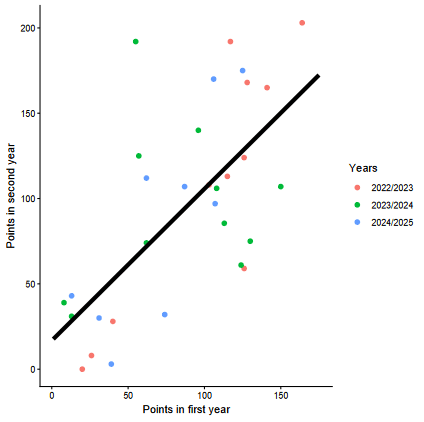
There is, however, quite a lot of scatter, so the linear regression (the black line) is not all that reliable of a model. In theory, our best guess of how many points a driver will score in their (n+1)th season in F2 is:
But it’s not a very good guess (OK, it’s an outright bad guess – this is not a particularly predictive data set). Certainly Isack Hadjar wouldn’t think so. After he scored 55 points in 2023 this model would predict him 65 or 66 points in 2024, but in reality he scored 192, narrowly losing the championship to Gabriel Bortoleto. More quantitatively, the standard error on the prediction means that the error bars on that forecast are pretty wide:
Now, statistically, there’s actually even more variance than that, as usually you’d quote the 95% confidence interval which is twice the standard error (and if you did, it’d basically tell you you were wasting your time, which I may have somewhat mentioned already). But I’m actually more interested in the 68% confidence interval you get from the standard error directly, as I think that provides a neat way to provide “good year” and “bad year” marks that several drivers will get to – and the idea that 1/6 drivers had a good year, 1/6 had a bad year, and 2/3 had a normal year has some intuitive value to me. So let’s go with that, apply those numbers to our returning drivers and see what we get:
| Driver | Points in 2025 | Bad Year | Best Guess | Good Year |
|---|---|---|---|---|
| Alex Dunne | 150 | 96 | 150 | 204 |
| Dino Beganovic | 116 | 73 | 120 | 167 |
| Joshua Durksen | 107 | 67 | 112 | 157 |
| Sebástian Montoya | 91 | 55 | 98 | 140 |
| Gabriele Mini | 72 | 42 | 81 | 119 |
| Rafael Villagómez | 43 | 22 | 55 | 88 |
| Oliver Goethe | 37 | 18 | 50 | 81 |
| Kush Maini | 32 | 15 | 45 | 76 |
| Ritomo Miyata | 30 | 13 | 43 | 74 |
| John Bennett | 1 | 0 | 18 | 42 |
| Cian Shields | 0 | 0 | 17 | 41 |
One reason there’s a decent amount of scatter, probably, is drivers changing teams between years. On that note, I think it’s worth noting that Joshua Durksen has moved from the notably inconsistent AIX Racing team to the currently-strongest Invicta Racing team, and Ritomo Miyata moved from ART to Invicta’s closest rivals Hitech, so those drivers are likely to make significant progress and I’ll assign them their “good year” scores. Dino Beganovic joins DAMS from Hitech, but that’s not likely to affect him too much as both teams were fairly strong last year. Similarly, Gabriele Mini moved from Prema to MP, but it’s not clear that MP’s lead over Prema in the teams championship was due to anything other than Richard Verschoor, since both Prema drivers beat Oliver Goethe in the other MP car. Speaking of Goethe, he joins Alex Dunne, Sebastian Montoya, Rafael Villagomez and Cian Shields in staying put, so all of those drivers are likely to be somewhere close to the best guess score. Finally, John Bennett moved from Van Amersfoort to Trident, which would be good if this was F3 but Trident’s F2 squad struggled badly last year; and Kush Maini went from DAMS to ART which is also a step back. So those two might be getting the “bad year” scores or thereabouts.
The F3 Graduates
Since F2 adopted its current calendar structure there’ve been 29 drivers who completed a full season of F3 and then missed no more than five races in F2 the next year. The relationship between their performance in F3 and how they did the next year in F2 is a lot tighter than the one for successive F2 seasons, though (with three notable exceptions):
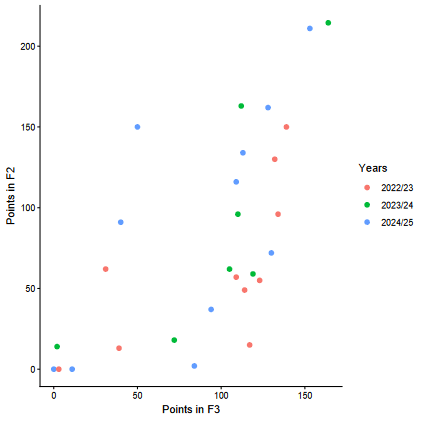
If we just sort of ignore the great strides made by Alex Dunne, Sebastian Montoya and Kush Maini (the three dots towards the top-left), the rest of these dots are clustered around what looks like a quadratic curve. In fact, if I kick out Dunne, Montoya and Maini, square the number of points scored in F3, and tell the regression modeller to adjust for the year (both for the strength of other drivers and because 2023 had fewer races in it) it gives me this:
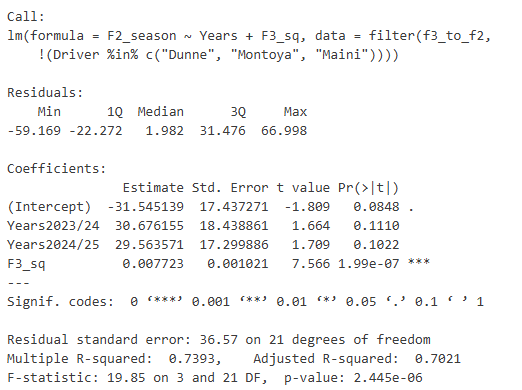
Which, if we put it back on a graph1, looks fairly reasonable:
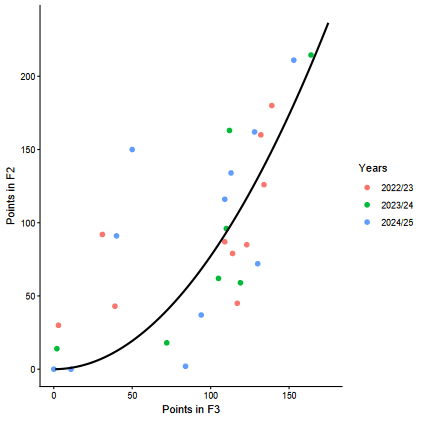
So in this case our predictive equation (lacking any better knowledge, we’re assuming no offset for the year) is
You might be surprised (I certainly was, when I first found this) that there’s so little scatter here, given that it’s well known teams have a fair amount of influence on a driver’s results in F2. I suspect what we’re finding is that for drivers coming up from F3, which F2 teams are available to you depends in large part on how well you did, whereas drivers already in F2 have more chance to move around. In fact, that might be why the effect is a curve, rather than a line – being good in F3 both means you’re a better driver, so you’d do better anyway, and also that you get a better car. Anyway, that means we’ve got these predictions for next year’s cohort:
| Driver | Points in F3 | Bad Year | Best Guess | Good Year |
|---|---|---|---|---|
| Rafael Camara | 166 | 185 | 213 | 241 |
| Nikola Tsolov | 124 | 103 | 119 | 134 |
| Mari Boya | 116 | 90 | 104 | 118 |
| Martinius Stenshorne | 89 | 53 | 61 | 49 |
| Tasanapol Inthraphuvasak | 74 | 37 | 42 | 48 |
| Roman Bilinski | 65 | 28 | 33 | 37 |
| Laurens van Hoepen | 60 | 24 | 28 | 31 |
| Noel Leon | 36 | 9 | 10 | 11 |
The Other Three
Colton Herta is the driver everyone’s watching. In theory, a seasoned pro such as Herta ought to be the strongest driver in the field, but his lack of experience on F2 circuits (he’s raced on some of them, but not since 2016) isn’t going to help. Ritomo Miyata’s struggles trying to translate his Super Formula skills suggests it’s not as easy as it looks, though unlike Miyata (until this year) Herta at least has the benefit of a top team. I’ll be disappointed if he’s not in the title battle with Camara (and possibly Durksen and Dunne).
Nicolás Varrone might be an ever wilder card. In the last couple of years, he’s been a pretty impressive GT3 racer and dabbled in prototypes. That’s normally something you move into after deciding your single-seater career’s not going anywhere further. He’s at Van Amersfoort, who provided Villagomez with a car able to make occasional points finishes last year, and if he matches that (or whatever Villagomez manages this year) it’ll be a decent return.
Nobody sensible would jump from Eurocup-3 to F2, and no team with self-respect would take somebody wanting to do that, but obviously that doesn’t describe either Emerson Fittipaldi Jr. or AIX Racing, who will likely have a very unproductive season together or alternatively part ways with alacrity. Sure, Kimi Antonelli and Josh Durksen both leapt from Formula Regional to F2, but Antonelli was the FRECA Champion. Durksen didn’t really have the results to justify a jump to F2 (and his strong performances at the tail of 2024 were a surprise), but they were distinctly better than Fittipaldi’s attempt at FRECA in 2023 (40 pts and 26 pts versus 4 pts).
Putting it all together
If I combine the two tables and my guesses as to which returning F2 drivers are likely to have a good year, we end up with something like this:
| Driver | Points |
|---|---|
| Rafael Camara | 213 |
| Joshua Duerksen | 157 |
| Alex Dunne | 150 |
| Dino Beganovic | 120 |
| Nikola Tsolov | 119 |
| Mari Boya | 104 |
| Sebastian Montoya | 98 |
| Gabriele Mini | 81 |
| Ritomo Miyata | 74 |
| Martinius Stenshorne | 61 |
| Rafael Villagomez | 55 |
| Oliver Goethe | 50 |
| Tasanapol Inthraphuvasak | 42 |
| Roman Bilinski | 33 |
| Laurens van Hoepen | 28 |
| Cian Shields | 17 |
| Kush Maini | 15 |
| Noel Leon | 10 |
| John Bennett | 0 |
Adding in the three drivers who did neither F3 nor F2 last year, I’d guess Colton Herta ought to score somewhere around 200 points as a title contender, Nicolas Varrone might match his team-mate Rafael Villagomez and score around 50, and Fittipaldi probably won’t score.
Now this turns out to not be quite enough points. There’s 2,016 total points available in an F2 year and I’ve only assigned 1,676. I think that might be a reflection of F3 looking pretty underwhelming last year and Camara having a higher % of points than usual. There’s a lot of different ways I could correct for that but this is, frankly, not a serious forecast and the points were mostly just an easy way to merge the F2 and F3 drivers. So I won’t bother and instead just note that the midfield drivers all really ought to do a lot better than this because somebody‘s going to have to score all the missing points and that’s where the discrepancy from the average points distribution is.
Ultimately what we’ve got here are two favourites in Camara and Herta, two drivers who might challenge them in Dunne and Duerksen, and some other drivers like Beganovic or Miyata who might spring a surprise or two but probably won’t be title contenders. It’s more likely to be a fight than F3 is, at least.
- What I’ve actually done here is cheat for the sake of making a better visualisation, and add 30 to the F2 points score from 2022/23, such that all three Year adjustments in the regression model would be very small; it’s easier to compare this way. ↩︎
 Motorsport Analytics
Leave a comment