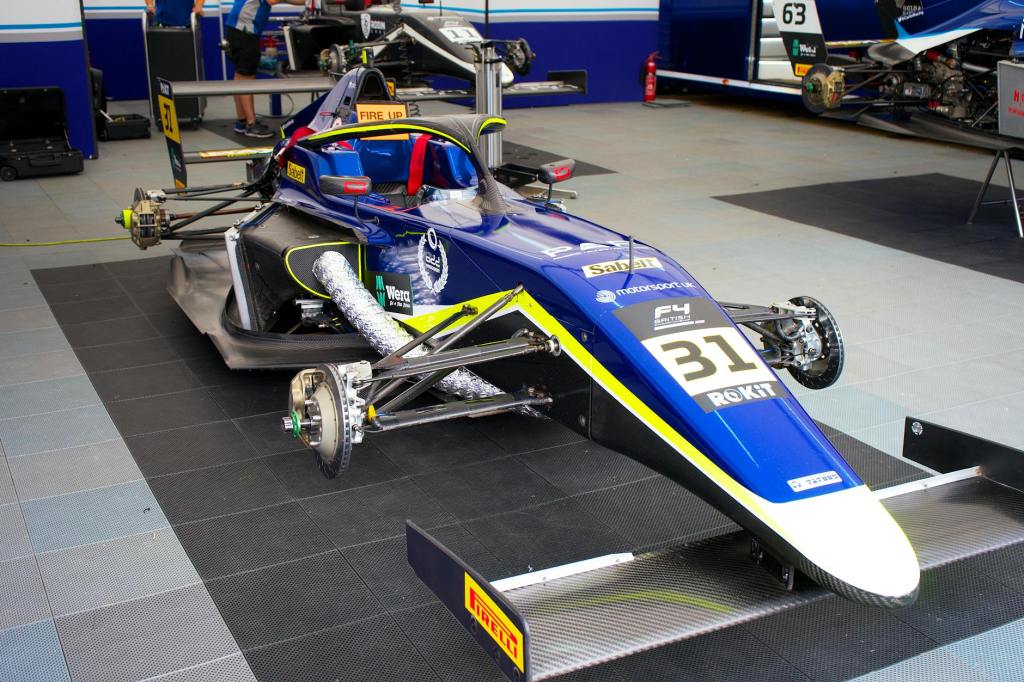
FIA Formula 4 meets the UEFA Coefficient
Since the FIA established the Formula 4 ruleset in 2013, 13 different FIA-sanctioned championships and a further 11 non-sanctioned championships which operate to more or less Formula 4 rules have been set up.
Some of you – hopefully, particularly given you clicked on this link – might have been wondering which of these series has the strongest level of competition. The conventional wisdom would have it that the answer to this question is Italian F4. That’s the oldest F4 series, starting in 2014, a year before most of the other long-running series. It’s also generally the largest, with field sizes often reaching 40 for rounds at Monza. But does that make it the best?
I am not aware of any previous attempt to answer this systematically, and given how much effort this turned out to be, perhaps that is not surprising. But I don’t know what the sunk cost fallacy is apparently and here we are; a systematic evaluation of driver strength in national F4 series between 2014 and 2020. (As you’ll see in a bit, my method precludes looking at later years).
Method
The problem, of course, with rating the strength of a field in any sport is that the competitors are primarily competing against each other. Accordingly, the question of how good they are as a group tends to be answered more on visual than statistical evidence. However, for a junior series like Formula 4 I think a forward-looking statistical approach is plausible.
The basic idea is that F4 is supposed to teach young drivers how to race single-seaters. Therefore, we can rate F4 series by how well they accomplished that. I took inspiration from how Europe’s football association, UEFA, ranks individual member leagues. In the case of football UEFA ranks leagues according to a weighted average of how each league’s teams have performed in the UEFA Champions League, Europa League and Conference League for the last five years. Similarly, we can rate F4 series by how well each driver performs in the five seasons after they compete in it (and now you know why this analysis ends in 2020).
The next question would be how to measure this performance. Since almost everyone who competes in F4 is doing so with an ultimate goal of entering the F1 World Championship, a reasonable answer to this question would be in terms of progress towards that. Fortunately, the FIA has already quantified this for us; to be qualified to race in F1, a driver must accumulate 40 Super Licence points. Therefore, “number of Super Licence points scored over the next five years” is a reasonable measure of how strong an F4 field was. I’ve also limited it to the top 10 drivers; if a driver who didn’t do well in an F4 season goes on to have a good career, that’s not a plus for the F4 series, as it suggests it isn’t doing a good job of separating out drivers with high potential.
This is a bad method and you should feel bad…
There are some problems with the use of the super licence points table. For one, the FIA keeps fiddling with it. To some extent that’s because racing series come and go; to some extent it’s because they change their mind about their value. I’ve used the current table where a series is in it, and the 2019 table where it isn’t, and so far that’s got most things covered, though different choices here might bring different results.
More worryingly, the FIA also use the points table as a means to promote their own series. Series not an official part of the FIA’s pyramid, such as GB3 or IndyCar, get fewer points than series which are, like Formula Regional and Formula 2. This is likely to have the effect of slightly promoting Italian and French F4, which feed into Formula Regional Europe. There’s a related question which is whether we’re trying to measure if an F4 series is doing a good job at launching racing careers of all types, or just single-seater ones. Some junior series create a lot of GT drivers, is that something we’re interested in? Ultimately I decided that replacing the FIA’s subjective assessment of series with my own subjective assessment of series was not a step forward and left things as they were, with the exception that I awarded 40 points for any season as a race driver in F1 since giving it no points seemed wrong and as it’s the “next step” after winning F2 it shouldn’t get fewer points.
In practice, all this has to be automated. Considering just Italian F4, the six seasons between 2014 and 2020 would mean having to research five seasons of 60 drivers (actually slightly fewer, due to repeats). So I taught myself how to webscrape Wikipedia and set to it. This does mean there’s an additional assumption that a driver who doesn’t have a Wikipedia article never scored any superlicence points, which is driven by me wanting not to make this any more laborious than it already was and also not wanting to research the webscraping policies of other websites. The result of this is that non-European F4 series largely drop out. Practically, I think this does reflect the nature of the FIA pyramid. Drivers who are serious about motorsport careers largely come to Europe unless they’re American or Japanese. That said, it’s definitely a limitation of this study and if I was being paid to do this I would certainly be more thorough; in the end there’s limits to how much drudge work one goes to just to satisfy curiosity.
There are nine FIA-sanctioned championships (the Italian, Japanese, British, Chinese, Mexican, Spanish, American, South-East Asian and French series) which existed prior to 2020 that are still active. There is additionally the Danish championship which still exists but lost certification in 2024. There’s Australian and Russian series which have now resumed but both ceased between 2019 and 2024, and ADAC (German) which lasted until 2022 before folding. The second British F4 series which has been known variously as BRDC F4 and GB4 existed from 2013-15, was changed into a national F3 series, and then launched a new F4 series below it in 2022. But since it only ran to F4 rules in 2015, I left it out. I looked at all the other series, setting a minimum sample size of at least 15 unique drivers (we’ll get into what you do with drivers who appeared in multiple years in a bit, but for sample sizes I wanted at least 15 different ones) from at least 3 different years. That meant I ended up with ten series (not all of which still exist):
| Series | Number of Drivers/Years |
| Italian F4 | 41 over six seasons |
| Japanese F4 | 30 over six seasons |
| British F4 | 43 over six seasons |
| NACAM (Mexican) F4 | 15 over five seasons |
| Spanish F4 | 20 over five seasons |
| United States F4 | 19 over five seasons |
| French F4* | 33 over six seasons |
| ADAC (German) F4 | 49 over six seasons |
| Australian F4 | 16 over five seasons |
| UAE F4 | 27 over four seasons |
*Not run to FIA F4 regulations until 2018, but I included 2015-17 anyway
Complications
Drivers do not, unfortunately, compete in a single F4 championship for a single season and then go off and do other things. In fact there’s two ways they don’t do that. The better-funded drivers often compete in multiple championships in a single year. It’s usually obvious which was their “primary” series, though, since there’s generally clashes so they’ll skip rounds in whatever championship wasn’t their priority. Lando Norris, for example, raced in every round of British F41 in 2015, three rounds of Italian F4 (out of 7) and three rounds (out of 8) of German F4. He won the British F4 title, finished 8th in Germany and 11th in Italy; so by my normal rules, he’d be counted in both the British and German championships for 2015.
That doesn’t quite sit right with me. The top drivers in German F4 didn’t have to beat Lando Norris, they had to beat what Lando Norris could do in fewer than half the races. So what I’ve done in these cases is discount the number of superlicence points the driver scored in the next five seasons – 198, in Lando’s case (including 80 points for two seasons in F1) – by the percentage of the season’s races they actually competed in. So British F4 gets the full 198 and German F4 gets 58, as Lando started 7 out of 24 races. Note that if a driver only raced in one F4 series that year, that series gets the full score even if they missed some races (such as Lance Stroll in Italian F4 in 2014, at least if I’d included 2014 in this analysis).
That’s the complicated complication. The easier one is that many drivers – not even necessarily the less talented ones – take a while to figure single-seaters out, and spend more than one season in F4. That means they often appear twice (or more) in the table for any given series. That’s fine though, since the unit for analysis here is the driver-year, not the driver themselves. For example, Williams reserve driver Luke Browning raced in British F4 in both 2019 and 2020, so in 2019 he scores the superlicence points he got between 2020-4 (61), and in 2020 he scored the points he got between 2021-5 (79).
You’ve Written 1,600 Words Get To The Point Already
Fine. The strongest F4 series using this method is Italian F4 (or, rather, it was in 2020), like the conventional wisdom has it. But that wasn’t actually true for most of the time. I’m gonna split this between the series that have existed for all six seasons 2015-20 and the ones that haven’t (though you could equally just as well say the good series and the bad ones).
The Good Series (ADAC, Japanese, British, Italian and French F4)
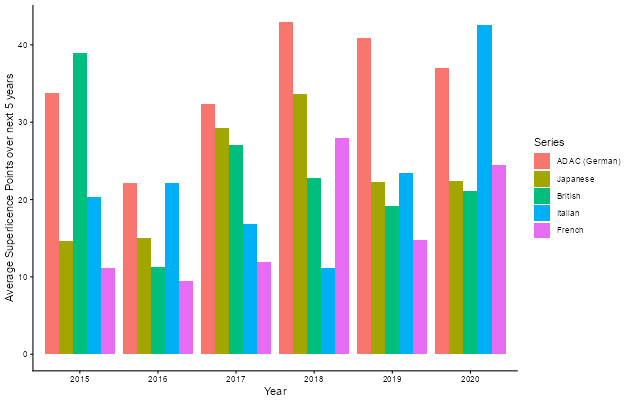
In 2015 the leading series was actually the British F4 championship, though that’s admittedly mostly powered by the presence of Lando Norris – but Colton Herta and Dan Ticktum also had fairly reasonable careers. After that the British series has consistently put up respectable but generally second-tier numbers excepting a Piastri/Sargeant powered 2017. A lot of solid drivers have come through this series, though quite a few who you might say would have done better with more backing (Zak O’Sullivan, Luke Browning), or have ended up going into non-F1 series (Louis Foster, Zane Maloney), or both (Alex Quinn).
In 2016 the top series was….well it was kinda UAE F4, but it doesn’t really deserve the accolade; it’s just that as it was technically in the 2016-17 season (which I counted as “2016.5”, meaning driver performances up to “2021.5”, ie 2021-22, we included) I don’t score it as clashing with any other series (since it didn’t), so it’s not getting Oscar Piastri’s and David Malukas’s part-seasons scored at 3/5ths. If I manually make that adjustment it drops to third, behind ADAC and Italian F4. The Germans then retain the lead until 2020, the series turning out plenty of drivers who went on to significant success (amongst them Marcus Armstrong, Nicklas Nielsen, Felipe Drugovich, Fabio Scherer, Dennis Hauger and Theo Pourchaire), though oddly only Liam Lawson reached F1 from ADAC F4 in this period. The last year in this analysis is when the Italians finally took over, with a year featuring Gabriele Bortoleto, Leonardo Fornaroli, Dino Beganovic and about a third of Oliver Bearman (his primary series was ADAC). I’m fairly sure they’d continue the lead into 2021 if I repeated this analysis one this season’s finished, since the top 10 from that ’21 season is headed by Bearman, and also features Kimi Antonelli (joining for the last three rounds once he met the minimum age), Leo Fornaroli, Tim Tramnitz and Josh Durksen.
As for the others, Japanese F4 is a bit of an odd duck. It’s only partially a feeder series and partially something a bit like a club series, and much the same goes for Japanese Formula Regional. Sometimes this means drivers repeat F4 when they would go up a category in other countries – which probably scores more points in some cases and fewer in others. In addition, the presence of Super Formula Lights alongside the Formula Regional series gives Japanese drivers multiple pathways that non-Japanese drivers frequently struggle to break in to. So while the series does put up some pretty solid numbers and has definitely produced some strong drivers such as Yuki Tsunoda, it’s maybe getting more points than it should.
French F4, meanwhile, while turning out a lot of names familiar to me as a fan of sportscar racing (Julien Andlauer, Gabriel Aubry, Yifei Ye, Charles Milesi, Arthur Leclerc, and Reshad de Gerus amongst them), generally seems to have produced drivers who’ve fallen short at higher levels, with the exceptions of Theo Pourchaire (2018 – the year before he went to ADAC F4 as mentioned above) and Isack Hadjar (2020). It’s arguable it’s strengthened over time, quite probably benefitting from costs in ADAC F4 beginning to get out of control.
The Bad Series (US, UAE, Spanish, NACAM and Australian F4)
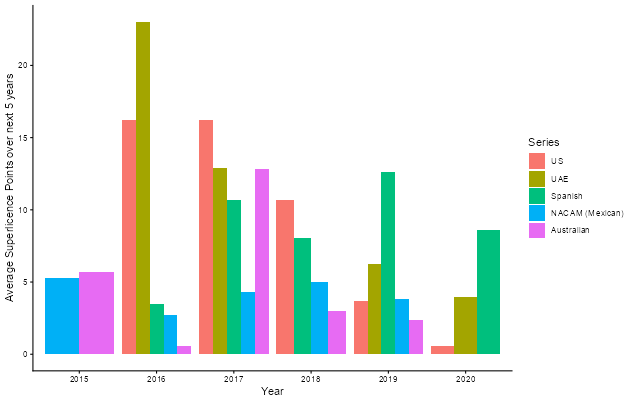
This is a pretty mixed bunch. UAE F4 has generally been a fairly small series which a lot of drivers have used as preparation for the European and American seasons, and in 2016 this happened to include Oscar Piastri, David Malukas and Fabio Scherer. Outside of this time period it grew into a fairly significant winter event, attracting large fields from 2022 onwards, so if we repeat this in a few years’ time it may well score significantly higher.
US F4 was a fairly strong series in the back half of the 2010s, featuring Kyle Kirkwood amongst others, but it’s generally been the case that much American auto racing talent either crosses the Atlantic to race in European single-seaters or alternatively races on the NASCAR or adjacent pyramid if they remain in the United States. US F4 and US Formula Regional have also suffered by competing with the Road to Indy series, and in general American talent seems to get quite diluted.
Spanish F4 might suffer, potentially, from tending to send drivers to Eurocup-3, which is kind of “Formula Regional Spain” but does not seem to be particularly good at sending drivers on to F3 or even really to FRECA. It’s also possibly a casualty of English-language Wikipedia, since quite a lot of drivers didn’t have articles and therefore didn’t get counted. Still there’s been a fair few drivers who’ve gone on to greater things (Franco Colapinto, Christian Lundgaard, Bent Viscaal, Richard Verschoor), or, err, “greater” things (Amaury Cordeel), but not so many as other series.
I might say a very similar thing about NACAM F4, and probably I should have tried looking at Spanish-language Wikipedia for these series, but I didn’t think of it and it’s a bit late at this stage. (On the other hand, in later years where Wikipedia’s heard of more of the drivers, the series doesn’t seem to do any better). There’s Pato O’Ward and Jak Crawford, Super Formula race winner Igor Fraga and noted palindrome Noel Leon, but beyond them nobody who scored more than 30 super licence points in the five years following their NACAM season.
Australian F4’s problem, on the other hand, is probably that it’s in Australia. Other than Liam Lawson and a few drivers who’ve gone into Supercars, there’s not a particularly natural route forwards out of that series which is probably why drivers have struggled.
Conclusions
So, we have our answer – based on the performances of their top drivers over the next five years of their careers, we’d currently rank the national F4 series like this:
| F4 Series | Average points per driver (2020) |
|---|---|
| Italian | 42.59 |
| ADAC (German, also defunct) | 36.96 |
| French | 24.50 |
| Japanese | 22.40 |
| British | 21.10 |
| Spanish | 8.60 |
| UAE | 3.98 |
Perhaps a better scoring method might be to take a weighted average of each year, ranking the more recent seasons more heavily – in that case we get this (giving 2020 a triple weighting and 2019 a double one)
| F4 Series | Weighted average points per driver (2015-20) |
|---|---|
| ADAC (German, also defunct) | 35.98 |
| Italian | 27.22 |
| Japanese | 22.70 |
| British | 22.43 |
| French | 18.18 |
| Spanish | 8.14 |
| UAE | 6.70 |
| US | 5.81 |
| Australian | 2.99 |
| NACAM (Mexican) | 2.77 |
To be honest, I think we’re mostly measuring how much money drivers have. ADAC was notoriously the most expensive series in this time – in fact the reason it dissolved was that it had got so expensive it couldn’t assemble a full grid and people were going to Italian and French F4 instead. But that does actually correlate quite strongly with driving performance – partly because richer drivers can afford more testing, and partly because top karting talents attract more sponsors. Proximity to F1 teams with their racing academies in Europe probably helps too – certainly many of the best non-European drivers think so, which is why Gabriel Bortoleto raced in Italy and Oscar Piastri in Britain. Even within Europe, there’s some signs the best backed drivers are now heading for Italian F4 even if, like its last two champions Freddie Slater and Kean Nakamura-Berta, they’ve got a perfectly good F4 series in the country their racing licence comes from (Britain, in both cases). I’m not sure that’s doing anything particularly for young Italian drivers, of course.
Does any of this matter? Probably. Why it matters is more open to interpretation. You can argue it’s a statistical illustration of inequalities in motorsport. You can argue it’s illuminating of the best places to use your money if you’re supporting a young driver (though you’d need to pair it with an analysis of the costs). I’m just a guy with a bunch of R code and a blog, I don’t think my interpretation’s any more valid than anyone else’s. I think one of the important things it does show is that, so far, the point of the F4 project – to largely democratise access to single-seater motorsport – has broadly failed. It’s true that there’s now entry-level single-seater motorsport series in more countries in the world than there were before F4 was introduced, but does that actually matter if most of them don’t really provide meaningful access to the rest of the pyramid?
Maybe I should more properly be blaming Formula Regional.
- actually it was called MSA Formula in 2015, for reasons I’m determinedly not getting in to ↩︎

 Motorsport Analytics
Leave a comment