I usually do these rapid quantitative previews as Bluesky threads, but frankly, this is going to be too long for one. I’m one of those “this post is longer because I didn’t have time to make it shorter” people). So here we are.
Median Laps
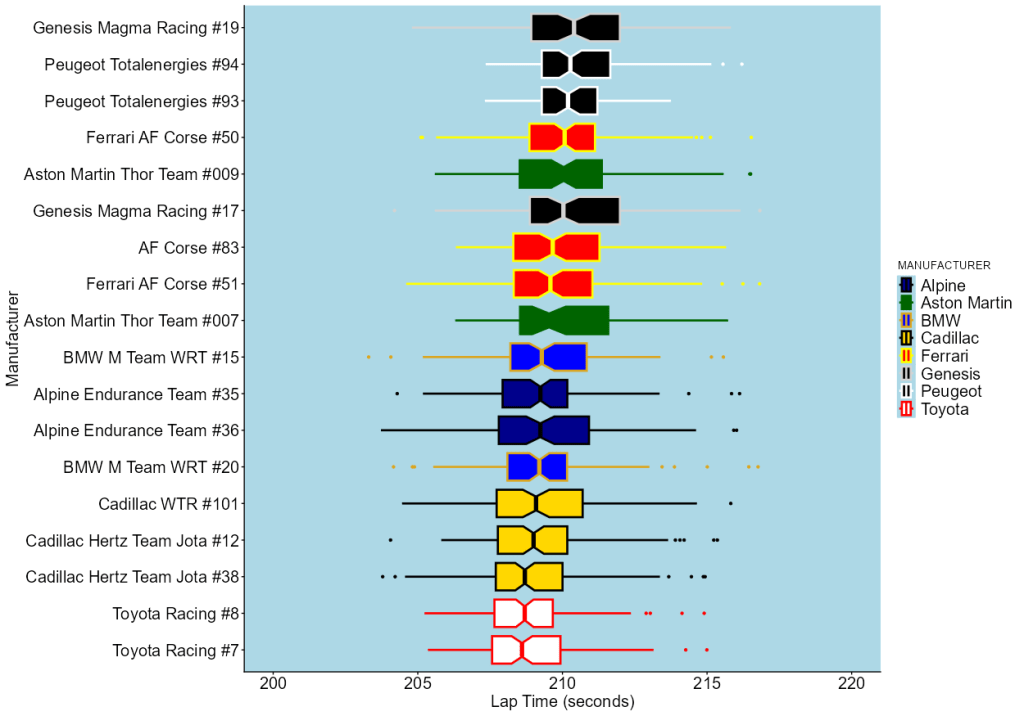
Let’s start with the simplest questions. Who’s been overall fastest, on average (by which I mean, who has the best median lap), in free practice (including the test day)? Last year, this was Ferrari, so it’s not a bad starting point. This year, it’s still an LMH constructor who’s qualified badly, but it’s Toyota. Cadillac, who I think are the conventional wisdom favourites, are second-quickest:
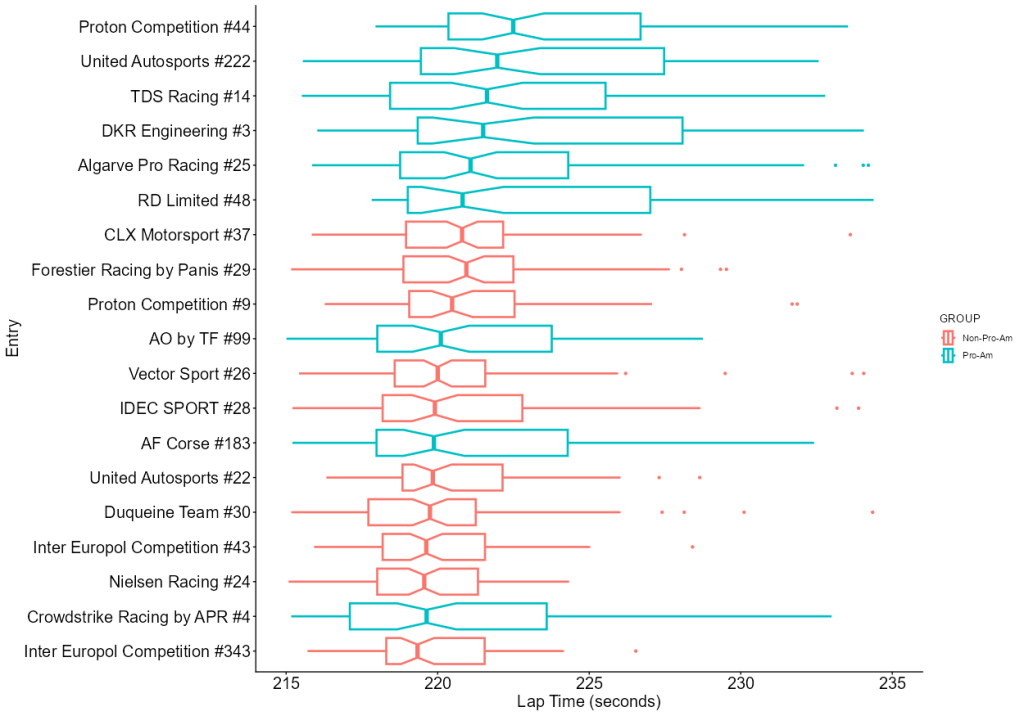
In LMP2 last year it was the Inter Europol #43 from the VDS Panis #48 in practice, who, again, contested the race until a late mechanical issue for the #48 gave the #34 victory. This time…it’s IE’s other car, the #343, though the Nielsen #24, the defending champion, the Duqueine #30 and the United #22 aren’t far behind. It could well be a close race. In Pro/Am, though, it looks mostly like the #4 will only be closely challenged by the #183, Note the Pro/Am (running a Bronze) cars have a much wider range of laptimes than the non-Pro-Am cars (running a Silver). This is not surprising as Pro drivers are quicker than Silvers and Silvers are quicker than Bronzes.
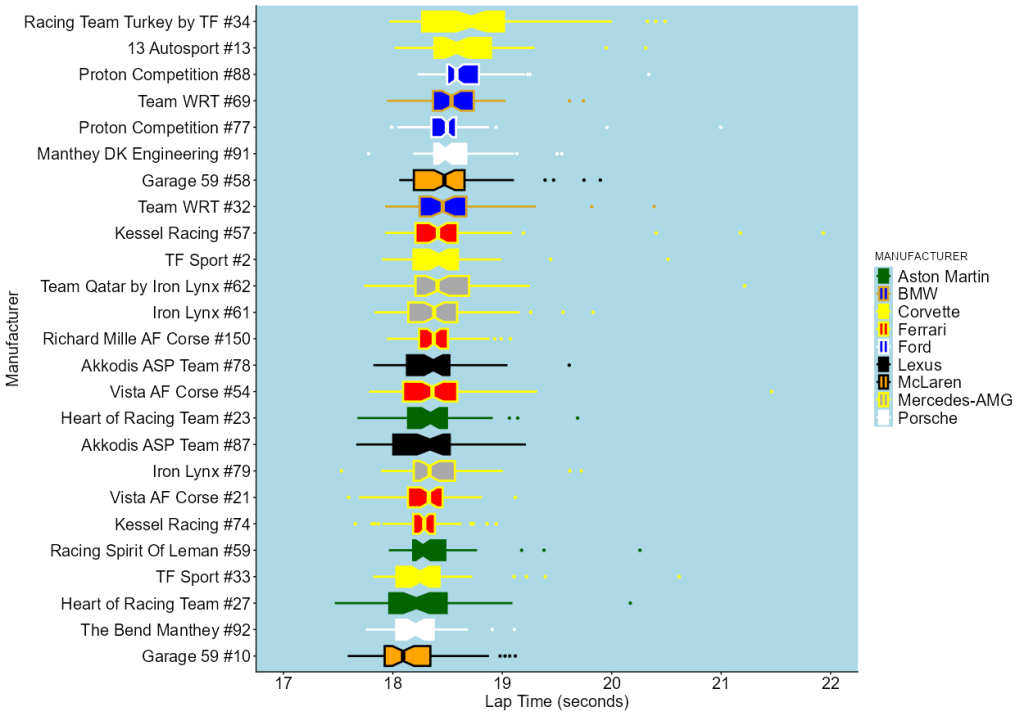
Last year this method suggested Lexus had the fastest GT cars, but this was probably an error on my part by averaging manufacturers together, since Porsche turned out to have the winning and slowest classified cars in the class…(not helped by the Iron Dames losing their Gold driver during the week).
I have decided against making that mistake twice, and with good reason, since the manufacturers mostly seem to be all over the place (good job with the BoP, I guess, ACO).
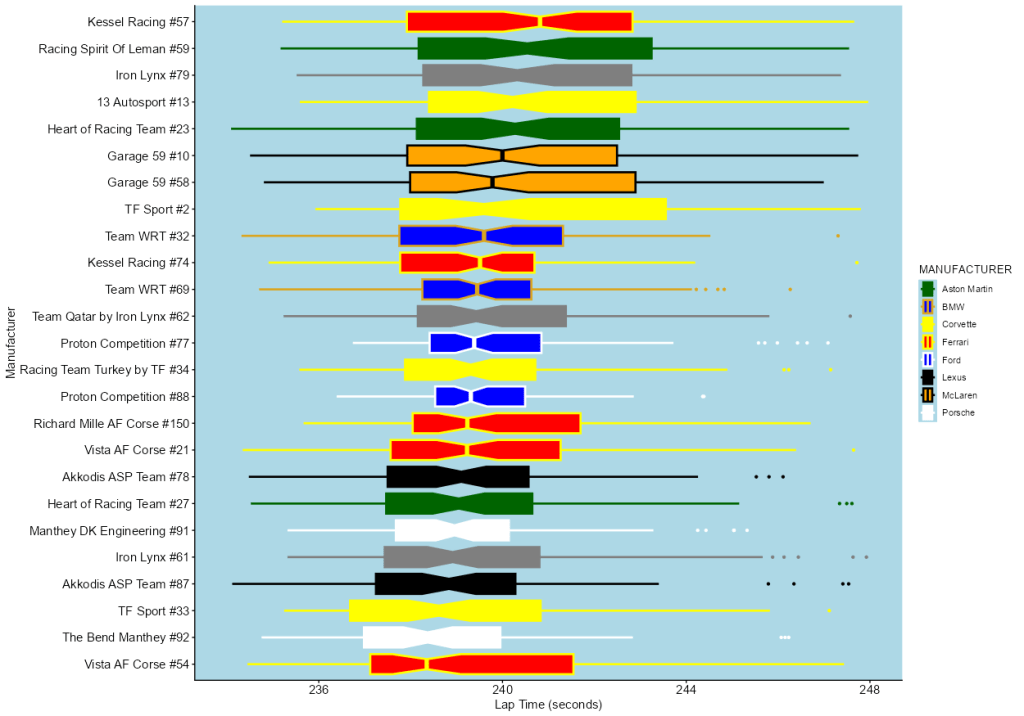
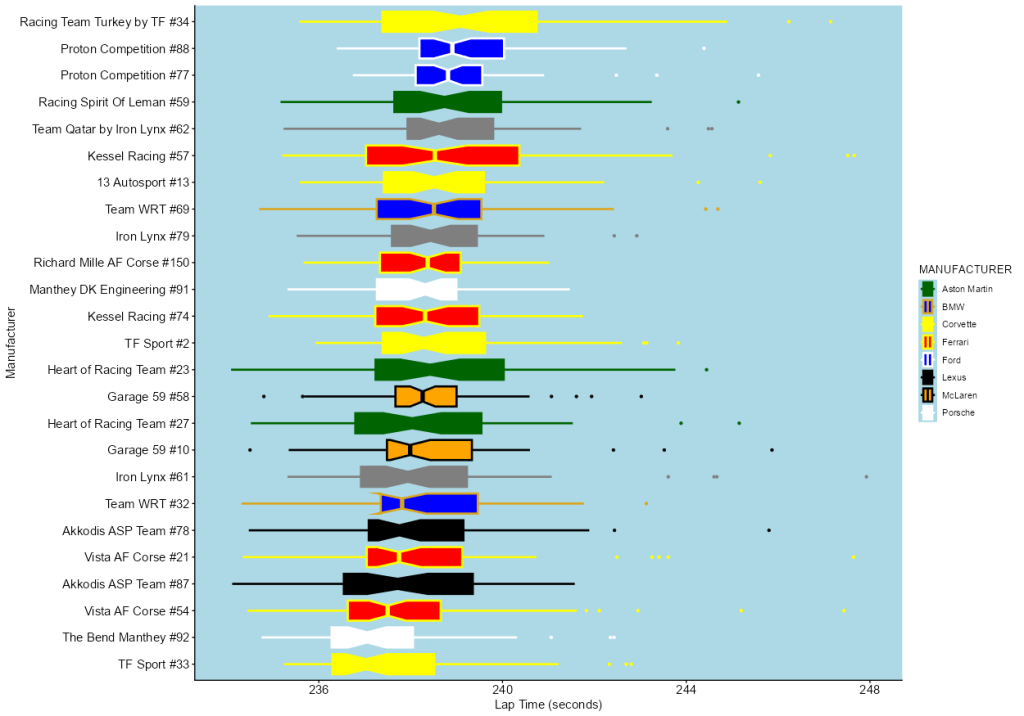
However, remove the Bronze drivers, who tend to have significantly more spread, to get more at the overall speed of the cars, and the #33 Corvette (Ben Keating’s lament he was just an average Bronze driver in GT3 compared to GTE might be optimistic, these days…) jumps ahead of the #92 and #54. Still, it looks like those three and the #87 are probably the main contenders.
Long Runs
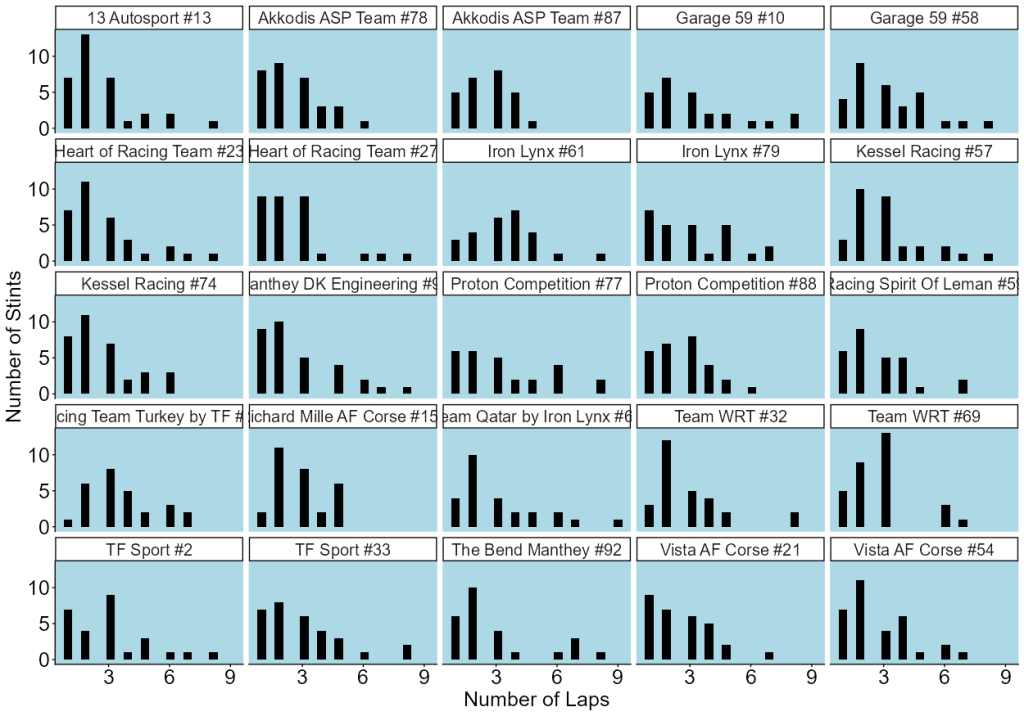
So that’s the basic status of how lap times are looking at the moment, what if we look a bit deeper? First off, how are the cars looking on their longer runs? I’ve thrown out any stint of five laps or less (and out laps, in laps and non-green flag laps) and then looked at the average time each car manages for the n-th lap. Technically it’s a smoothed loess method but that doesn’t really matter it’s basically a way to make the graph look a bit less pointy than taking a straight average. Now this still includes things like getting stuck in traffic, but then so will the race.
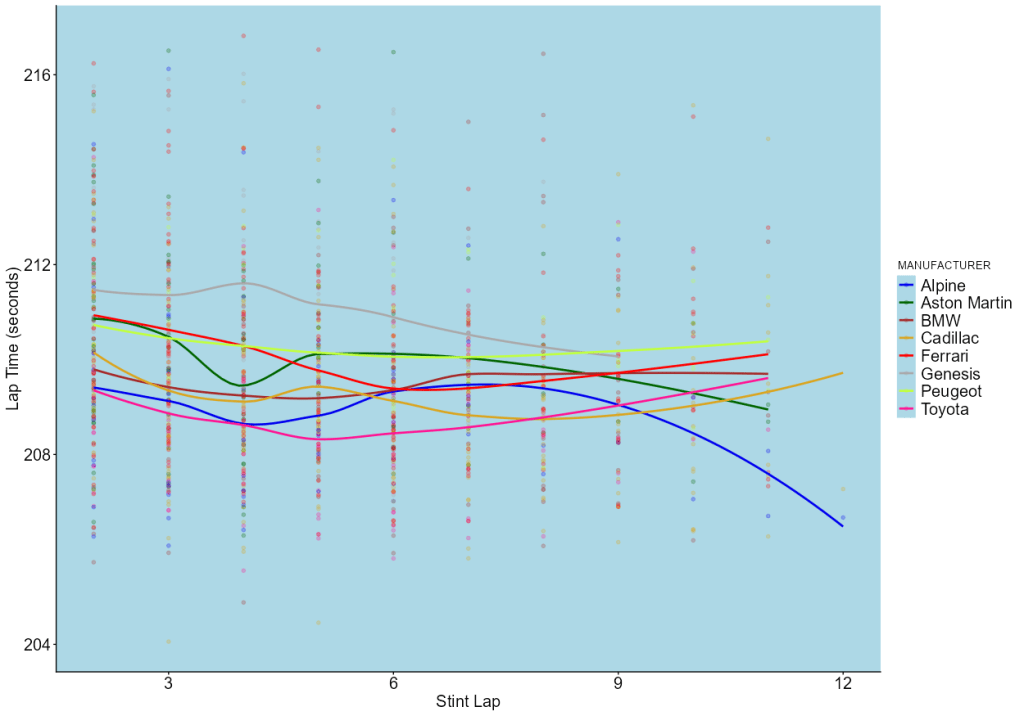
Yes, apparently, Alpine and Cadillac did 12 lap runs. They were both at the start of FP3, Jules Gounon and Sebastian Bourdais were in the car, and I’m not sure I believe in either of them. Anyway on this metric I like Alpine, Caddy and Toyota again, with the Americans looking weaker early on maybe and Alpine being strongest at the end of a stint.
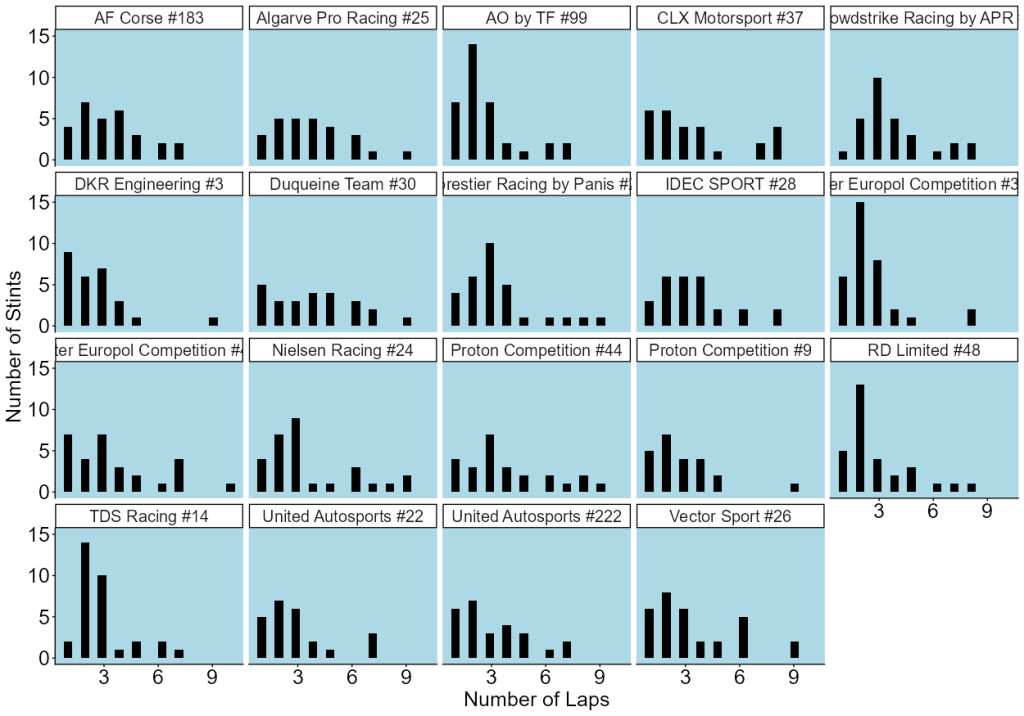
I’m not going to try this presentation method for the LMP2 cars because there’s just too many of them for it to work. But looking at the graph myself and spending far too long trying to work out who was who, I think Nielsen look great at the back end of stints, Inter Europol and Panis are good at the start, and Duqueine have the best pace in the middle. It does seem that in general Nielsen did more long runs, so the simple averages may have been underestimating their pace:
In GT3, it seems like the Ferraris are the best on their tyres if late stint pace in testing is anything to go by, with the #92 Porsche also up there. All the main contenders seem to have had fairly similar run plans, though.
Track Temperature
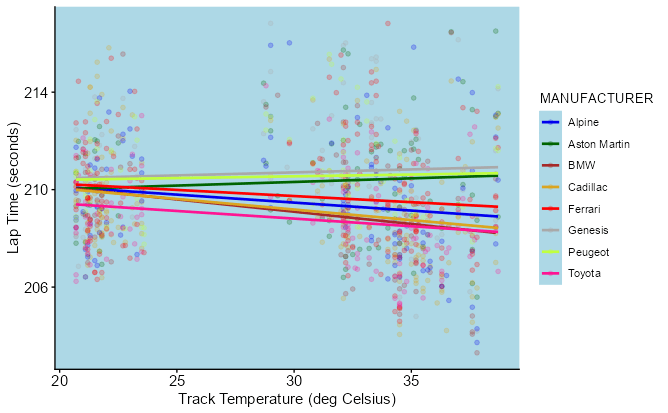
Le Mans, being a 24-hour race, includes some night-time running (I hope I’m not introducing too advanced a concept here). That means the track temperature varies quite a lot during the course of the event. Fortunately, ACO are sensible enough to organise night-time practices, so we’ve got some idea of how fast the cars run in cooler night-time conditions. Let’s take a look. Here I’m just plotting lap time against track temperature and then trying to fit a linear model to it. (This is because if I use a loess it goes silly in the middle bit where there’s no laptimes)
Toyota seem to have a big advantage in the cold conditions. That might well reflect ability to make the soft tyre work for them better, or to run the medium longer; unfortunately the analysis files don’t include tyre compounds. This also seems to be basically where the overall advantage comes from – there’s nothing to choose between them, BMW and Cadillac in hotter conditions.
Also Peugeot, Genesis and Aston Martin seem to be better at night? I have no idea what’s going on there, but I suspect some of this may relate to Genesis and AMR at least going harder in the night-time sessions due to their lack of experience with them.
Again this would be a forest of lines if I tried it for LMP2 and GT3, and with Bronze drivers getting required night-time laps in I’m not sure if it’s even meaningful overall. For the P2s, Inter Europol look great in the day, Nielsen and Duqueine improve at night (but both have pro drivers who’ve not done it before….so again it’s probably not real).
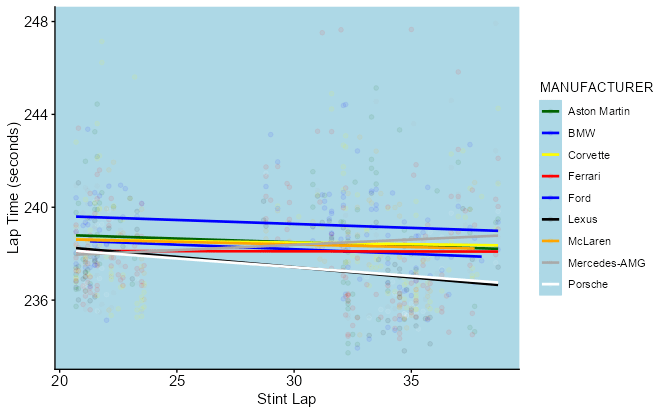
There’s not a lot in it with the GT3s, really. The Lexus seems to struggle a bit at night, but not a lot of difference for anyone else. Seems like if any car really likes the cold it’s the Mercedes, but they’re not on the pace overall. Again though there’s an issue here with Bronze drivers getting night laps in.
If I remove the Bronzes and just look at manufacturers (in theory, it’s the same drivers, right?) Porsche and Lexus both get rather worse and Mercedes remain as the biggest improver.
Section Analysis
There’s two subsections of the track I think might be worth a closer look, as they’re rough proxies for “drag” and “downforce”. Namely, who’s fastest in sector two (which is the Mulsanne straight), and who’s fastest through the Porsche curves? We’ve also got the actual speed trap figures, so I’m curious if the fastest at the traps are also the fastest in S2 overall, or if the chicanes are key.
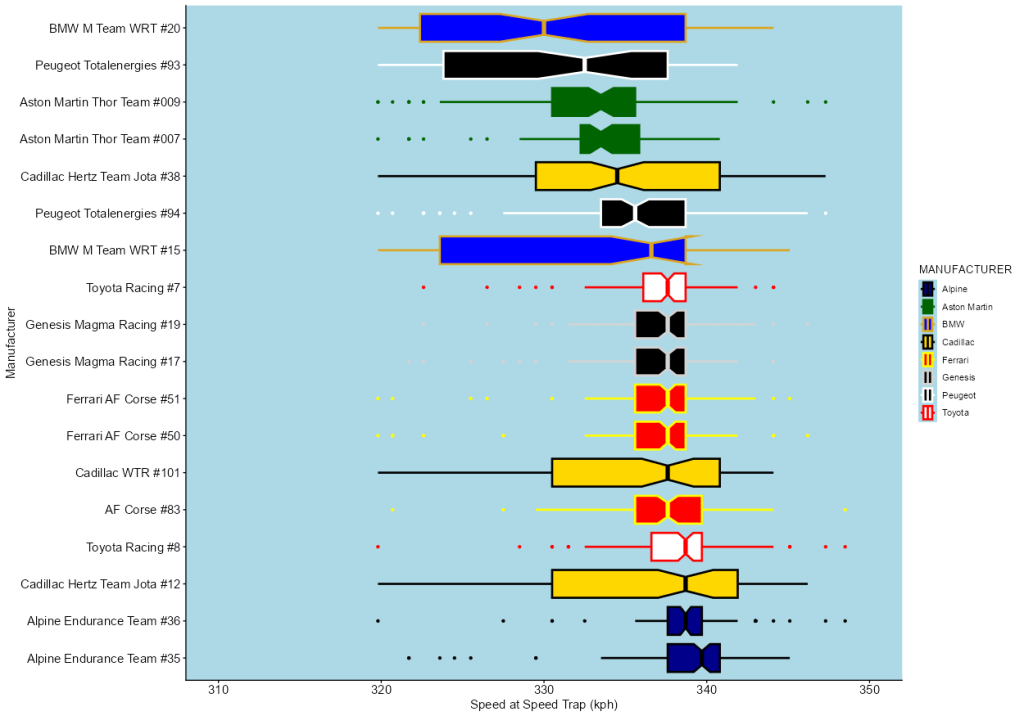
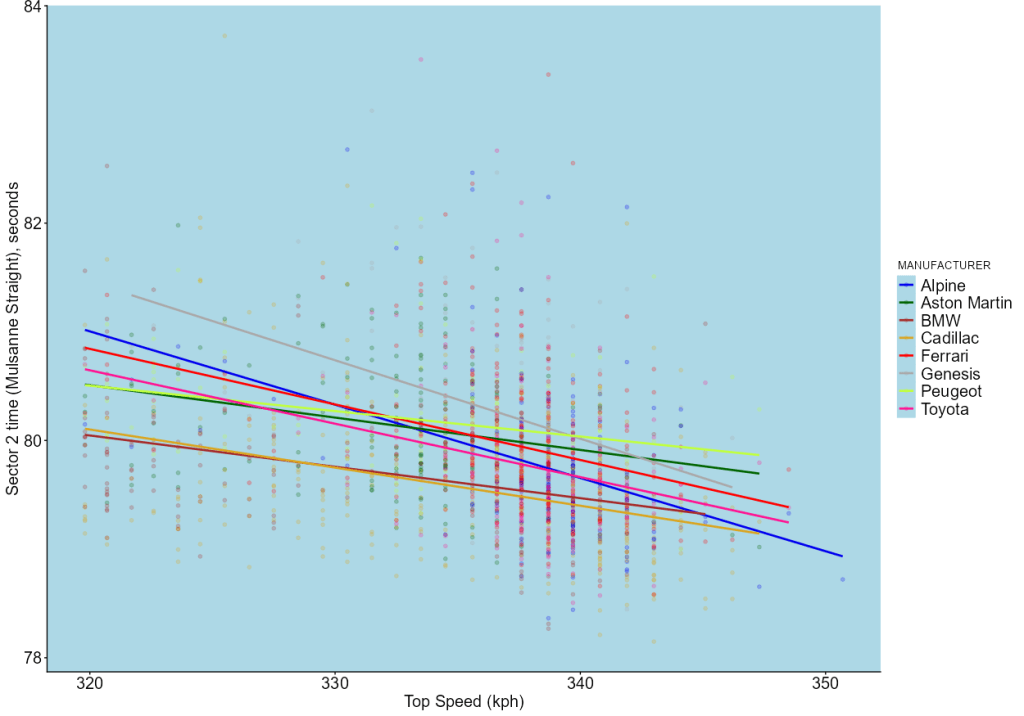
The absolute fastest anyone’s gone is Jules Gounon, who clocked 350.7 kph (~219 mph) in FP3, though as that’s 2.2 kph faster than anybody else has managed he probably had a pretty decent tow. On the other hand I said that about Antonio Fuoco last year and then look what Ferrari did. On average it’s been Alpine quickest through the speed traps, but for some reason generally only the #35, with the #36 being broadly in line with everyone else (usually). The wide ranges observed for BMW and Cadillac, though, make me think a certain amount of sandbagging may have been going on, which would also explain why Toyota sound much less confident than you’d think they ought to based on everything I’ve said so far:
Comparison between the sector 2 time and the speed trap reveals something interesting. BMW, Cadillac and Peugeot lose much less time on the Mulsanne by being slower at the speed trap. Does that mean they’re braking earlier, maybe? Doing more lift and coast (which would kinda go with the sandbagging theory, maybe)? If so, whatever it is Alpine are maybe doing the opposite. I am officially Intrigued.
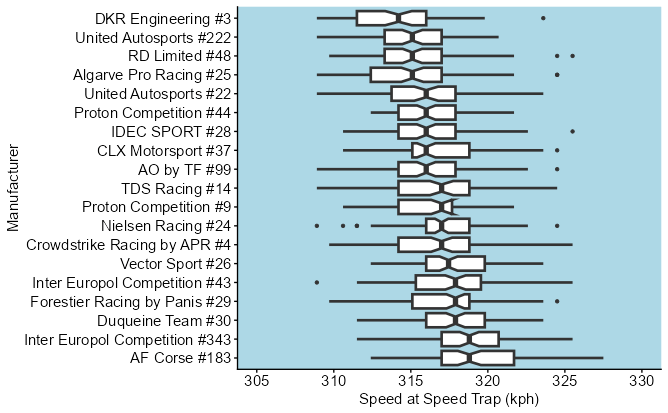
In LMP2, it looks like the secret to Inter Europol’s impressive performance with the #343 is that they’re significantly faster in a straight line…much as they were with the #43 last year. Does somebody want to check the Gibson offices to see if they’re unusually well-stocked with bakery products? That said, Duqueine and Panis are (just) quicker than the other IE. AF Corse’s 183 – which is a Pro/Am car and will drop back when Perrodo is in – definitely has the tools to interfere in general.
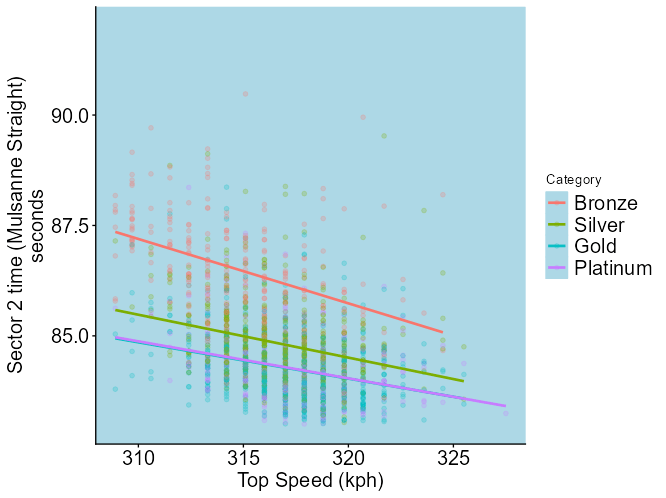
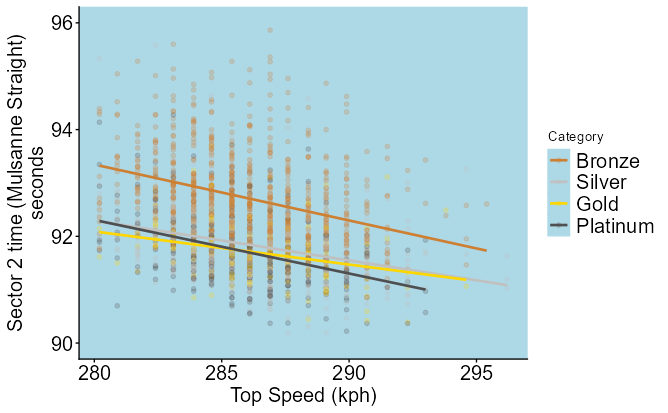
There’s the same general lack of a linear relationship which applies across cars between the sector 2 time and the top speed, though this one suggests it might be something to do with the chicanes, inasmuch as the Bronzes lose more time from going slower than the Silvers, who in turn lose more time than the Pros do:
Well this is nice and simple. Corvette have a speed advantage. Ferrari have a speed disadvantage (it doesn’t change that much if you remove the Bronzes). That makes sense if they’re good on tyres – probably more downforce, more drag and therefore less speed but more tyre life.
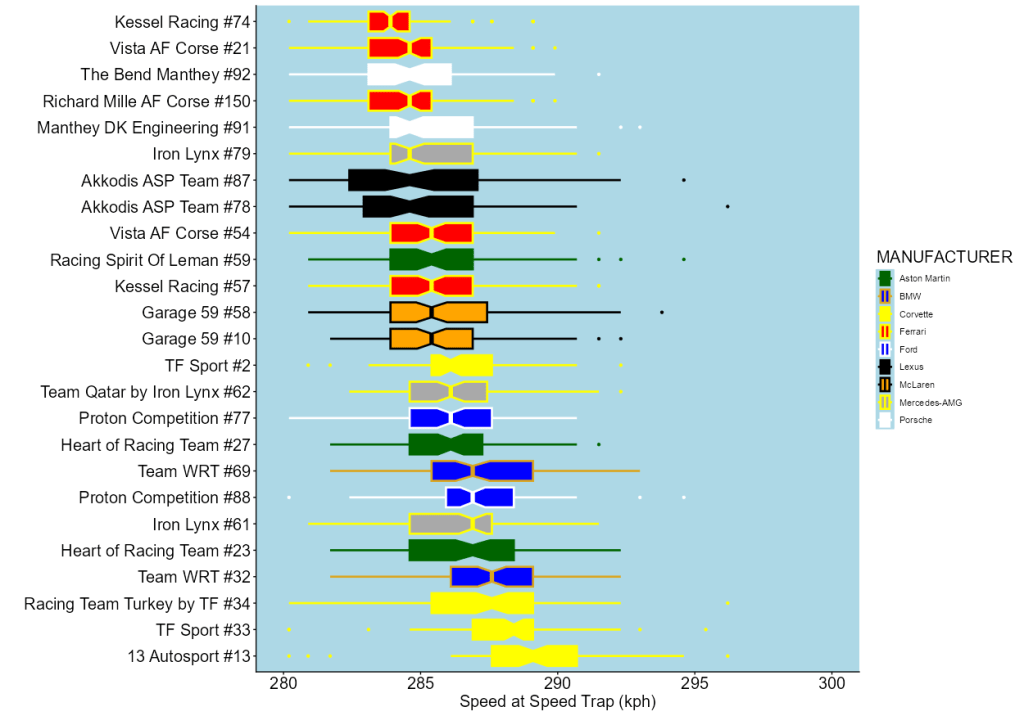
It’s interesting that the relationship between speed and sector time is much more similar in GT3 (Bronzes are still slow, but they get about the same amount slower for every kph they lose that pros do). That suggests it’s about braking, since (again pace Ben Keating’s complaints) ABS makes braking late much easier for Bronzes in GT3.
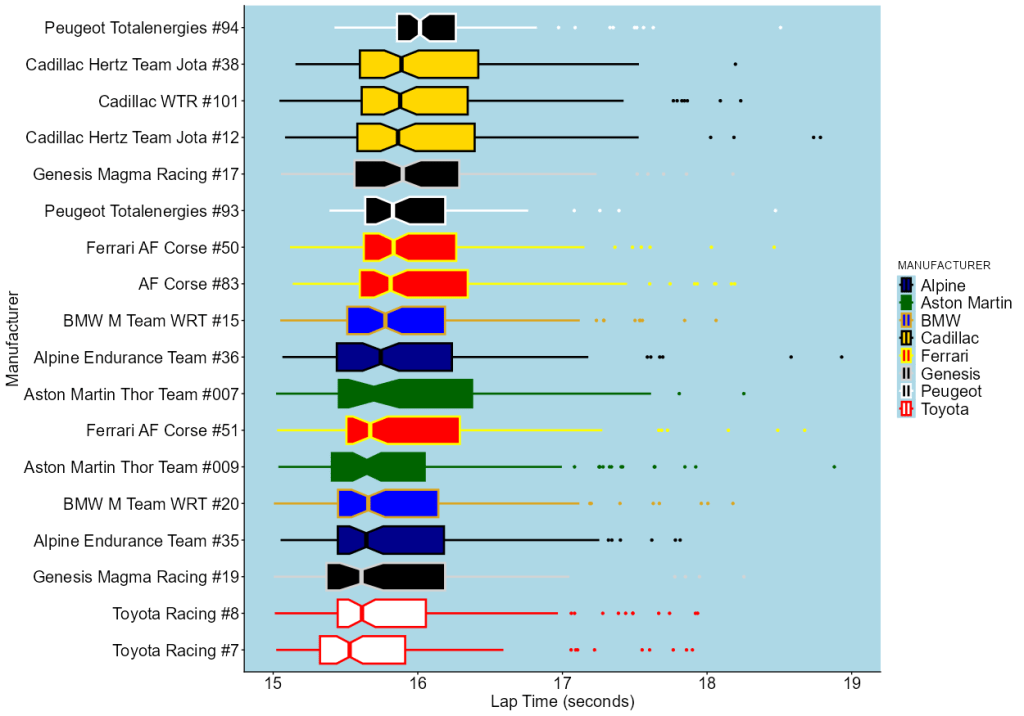
Anyway, enough of me going down a possibly-irrelevant rabbit hole. What about the Porsche curves? In Hypercar, the Toyotas were quickest, which makes sense because they were quickest overall and we’ve already seen they weren’t the best on the straight – they had to be getting that lap time somewhere. Of course this does suggest that Toyota will need a clear track to make the best of their pace, which comes from aero efficiency/downforce rather than straight-line speed.
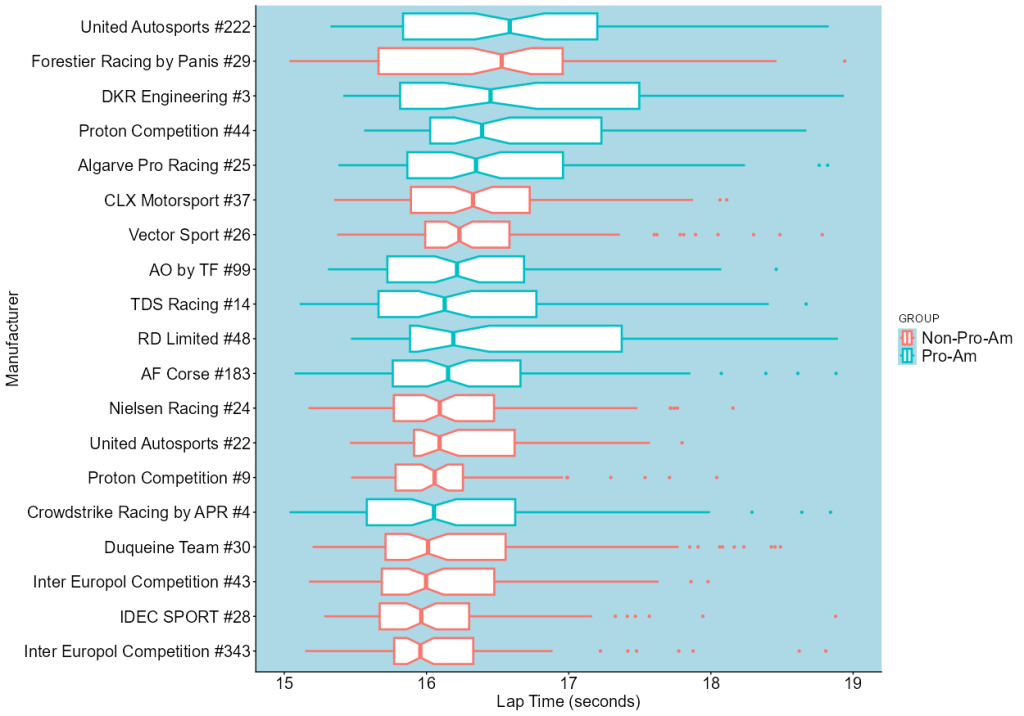
In LMP2, it’s mostly the usual suspects, minus Nielsen but with IDEC showing up for some reason (more wing? They weren’t that slow though).
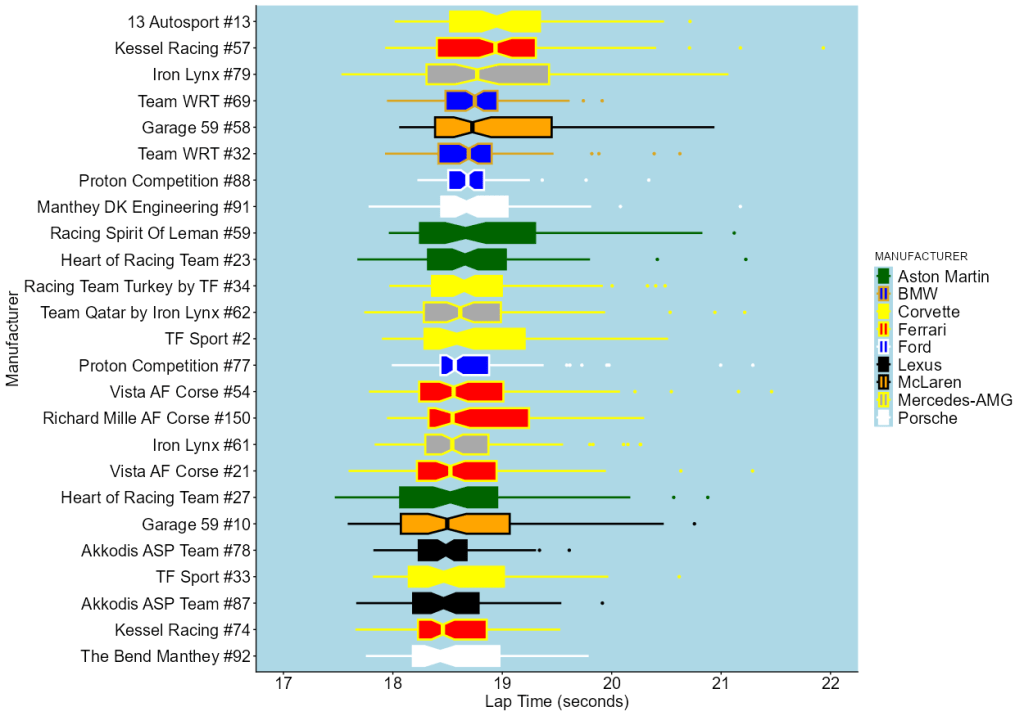
Fittingly, it’s a Porsche that’s fastest through the Porsche curves (I have not checked if the Mustangs are quickest through the Ford Chicane), and not surprisingly it’s the #92. There is, however, very little in it, and if you move the Bronze drivers it’s actually the #10 McLaren (whose Bronzes have definitely been struggling, with both cars eliminated in qualifying) which is fastest.
What does it all mean?
Watch the race and find out! Hypercar…well, the consensus is that it ought to be a fight between BMW and Cadillac, but don’t be surprised if Toyota get in amongst them, particularly at night. Alpine, too, if they can get ahead, could be difficult to stop with their straight-line speed.
Reluctantly I have to make the Inter Europol #343 favourite for LMP2, but the other IE car, Duqueine and Nielsen are all in the hunt. In GT3 I think the #33 Corvette, #54 Ferrari and #92 Porsche are probably the leading contenders, but it looks pretty wide open to me.
The code quality is…slightly better than last year (I have indeed fixed at least one error while writing this), probably, but I still wouldn’t place any bets on this!


Leave a comment