
Some thoughts on who’s doing better/as well as/worse than expected so far this year…
The F1 midsummer break seems as good a time as any to take a bit of a step back and make a general gaze over the motorsport vista that’s been provided so far this year to see what parts of it seem the most sightly. I have, according to my tracking sheet, watched 132 (and a third) races, so surely some things must have stood out. And indeed they have, so I thought I’d write about five good surprises, five things that have lived up (or down) to their promise in a notable manner, and five letdowns.
Nice Surprises
Let’s start with the good bit and then I can get progressively more jaded as the piece goes on, which is how all the best writing works, right?
Campos Racing (Formula 2, Formula 3)
Also-rans with the previous generation of top-flight feeder series machinery, Campos took a big step forward with the introduction of the new F2 (2024) and F3 (2025) chassis to become genuine contenders in both series. That was impressive enough, but this year they’ve made further gains and are now the dominant force in both, currently 2nd, 3rd and 4th in F3 (or in other words, it’s only Freddie Slater who can keep up, more on which later) and 1st and 5th in F2, winning fully half the races in the senior championship.
It’s so impressive, in fact, that it’s kept both Ugo Ugochukwu and Nikola Tsolov out of this list; they’ve both done very well, but under the circumstances I feel like the “surprise” element of their performance (ie, I was expecting them to be good, but not this good) has come from Campos.
Felipe Drugovich (Formula E)
Since Jake Dennis arrived in Formula E in the 2020-1 season, his Andretti team-mates have not, in general, had the best time of things:
| Season | Team-Mate | Dennis Points | Team-Mate Points | % |
|---|---|---|---|---|
| 2020-1 | Max Gunther | 91 | 66 | 73 |
| 2021-2 | Oliver Askew | 126 | 24 | 19 |
| 2022-3 | André Lotterer | 229 | 23 | 10 |
| 2023-4 | Norman Nato | 122 | 47 | 39 |
| 2024-5 | Nico Muller | 93 | 48 | 52 |
Andretti had tended to be something of a one-car team even before Dennis showed up, so Drugovich was definitely not met with particularly high expectations on his full-season debut (he’d done Berlin with Mahindra last year). And for the first seven races he met those low expectations, scoring no points and making his biggest mark by driving into the back of Antonio Felix da Costa on what had been his best run up to that point. But six points finishes in a row, a podium in Monaco and pole at Shanghai brought him 65 points, which is more than Dennis scored in those races. While he didn’t score in Tokyo (while Dennis took a pole, a fastest lap, and two podiums), Andretti have already seen enough to confirm his seat for next year (as you can see, that’s also something of a rarity), and a strong performance in London will send him into Gen4 on a high note. An impressive turnaround.
BMW M Team WRT (WEC Hypercar)
For most of the World Endurance Championship’s “platinum era”, BMW have kind of just been there. When I made a Bluesky thread giving a reason to support each Hypercar team last year, I actually gave up on them. But things have changed. Whether it’s the additional race mileage they’re getting in IMSA, the changes made to the car for the Windshear re-homologation, the addition of Rahel Frey to run the GT3s giving the rest of the leadership more focus on Hypercar, or something else, WRT have figured out how to win.
From no race wins and only three podiums in their first two years to two wins and running Toyota close at Le Mans in the first four races of this year is a heck of a step forwards and I definitely didn’t see it coming.
The Formula Regional European Championship
FRECA was something of a joke amongst junior series – it was important, sure, and it turned out drivers like Kimi Antonelli and Rafael Camara, sure, but it was famously (amongst the sort of people who watch these things) dull. The car was both ugly and could not follow, so races tended to be processional and dominated by qualifying pace, and you couldn’t even claim the sheer number of cars produced a great spectacle because they were all hideous.
Things have changed. FREC (Alpine are no longer providing the engine or a sponsorship, so the A has dropped off)’s new car is both beautiful and able to follow:
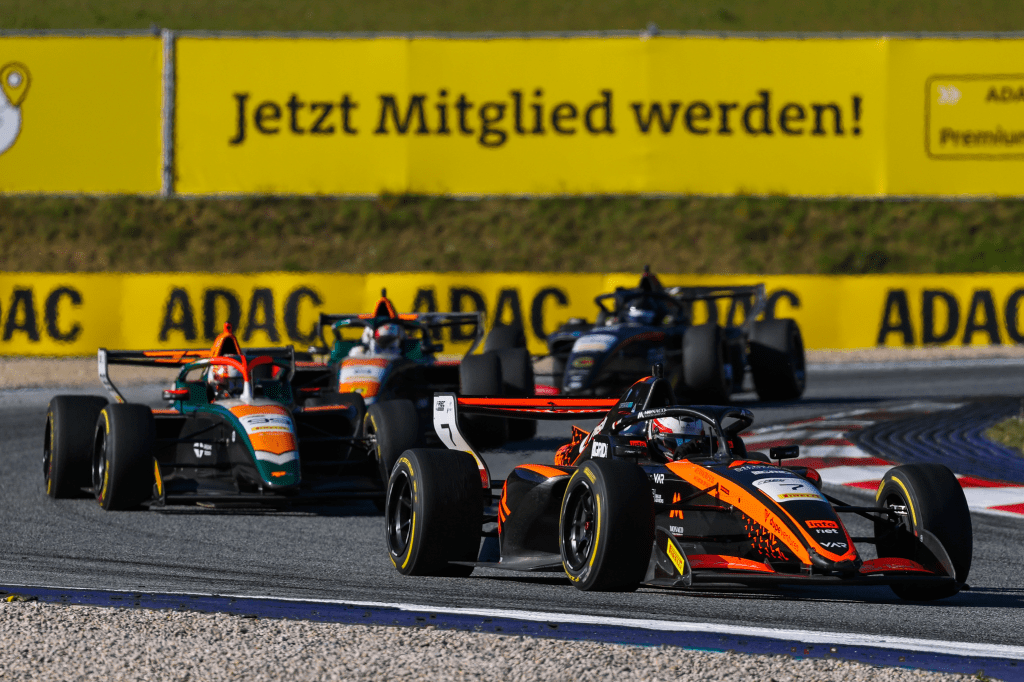
Tatuus clearly having realised they’d found a good formula with the GB3 design have tweaked it a bit to fit Formula Regional specifications, and after a bit of a false start in the Middle Eastern series they’ve got the push-to-pass working well (though it’d be nice if, like in IndyCar and Super Formula, the telemetry told you how much each driver had left). The result has been genuinely exciting racing. It’s also been a lot of safety car interventions as a field that’s not used to being able to get close to each other turns out to not be particularly great wheel to wheel, but hopefully that’ll diminish over time…
The ACO’s Balance of Performance
After two seasons of manifestly failing to get the BoP right, wherein many races were one-sided and even the few that were competitive rarely involved more than two teams, the ACO appeared to have given up, refusing to publish their BoP in the 2026 season. Hopes were not, in general, high.
But – very probably aided by both the re-homologation of all the cars and the departure of Porsche, who by some way had the best LMDh car – this year has shown a marked improvement. To be sure, only Toyota and BMW have won races, but Toyota’s victories have come at least as much on strategy as raw speed as they’ve thought their way around lacking straight-line performance, and BMW have had their own troubles with Alpine, Cadillac and Ferrari. While not everyone is in the race at every track, every race has featured a fight between at least three manufacturers and that is impressive progress from the ACO.
I mean, they can’t manage to make Peugeot competitive (other than Malthe Jakobsen’s qualifying heroics), but it’s a handicap system, not a miracle factory.
Lived Up and/or Down To The Hype
Most of these are, to be fair, living up.
Doriane Pin (ELMS)
As a fan of Doriane’s, I was very worried coming in to this year. After two underwhelming seasons in single-seaters, was the sportscar magic still there? It didn’t take long to find out that it was – in testing she was immediately matching and then exceeding the pace of Richard Verschoor (somebody who she would clearly not have been close to in single-seaters). Then at the first race in Barcelona a stint-long duel with platinum-rated Dane Cameron followed up by a 7th-to-3rd run at Ricard and topping her qualifying session at Le Mans and we knew the superest Silver was back.
Of course it turned out that her wretched sportscar luck was back too, as the Duqueine’s suspension broke having lead for most of the first 20 hours of Le Mans (to be fair, I think their most likely finish position was either 2nd or 3rd, as they were struggling to match Inter Europol’s pace once IE burned all their Silver time). But it’s hard to blame her for that.
It’s great to be optimistic about Doriane’s career again (though there’s probably not that many opportunities going in an uncertain-looking Hypercar field, I do think she’ll probably get a chance in the 9X8 in the Asian Le Mans Series…). It would be nice to see Mercedes realise she was the best Silver-rated GT3 driver they had on their books, though…
The Toyota TR 010 (WEC)
After an extremely poor 2025 season brightened only by a dominant performance at the final round in Bahrain (always a Toyota track and this time aided by a friendly BoP table), there was significant pressure on the aerodynamically reworked and renamed TR 010 (I wish they’d incremented the number, personally) to perform. Wins at Imola and especially Le Mans have shown that they’ve still got it – but what was much more impressive was how they won.
Toyota shot themselves in the foot quite a lot in a period starting in the second half of 2024 and extending throughout 2025, so while it wasn’t particularly surprising to see them winning races, what was a surprise was how. They didn’t have much in the way of a pace advantage in either race and have been struggling to overtake, but clever strategy has found them clear track and when he had to pull some moves at Le Mans Kobayashi – an absolute liability I’d been half expecting to retire after 2025, but who’s come back strongly this year – found a way. They did go absolutely AWOL at Sao Paolo, though, so it’s not all good from the Cologne squad.
Freddie Slater (FIA F3)
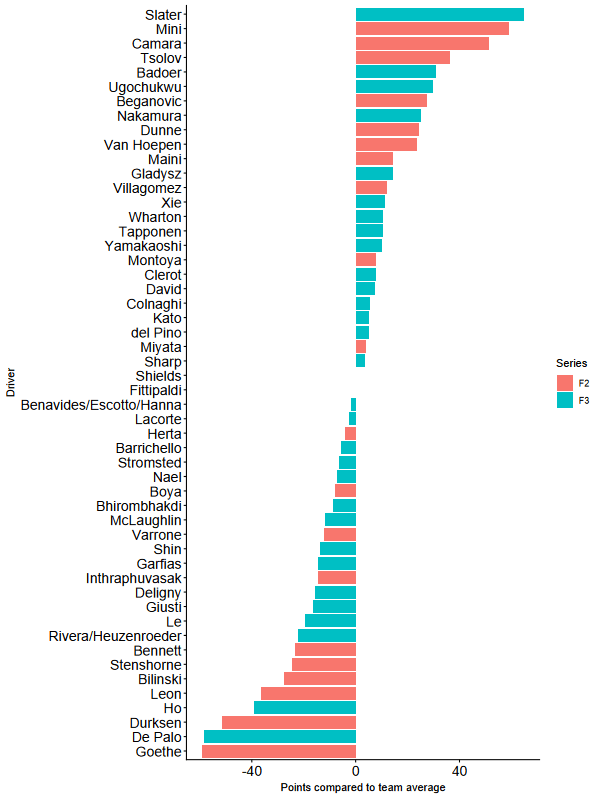
Slater entered this season with a fearsome reputation to live up to having absolutely stomped the lowest tiers of the FIA pyramid, breaking records in Ginetta Juniors, F4 and FRECA. He’s not managed to do that in F3 and for a while I was considering him a bit of a disappointment, but as the season has progressed it’s become increasingly clear he’s fighting a solo battle against Campos’s clearly superior mechanical knowledge. In fact, if you look at how many points each driver in F3 and F2 got compared to the team average (F3 drivers have two team-mates, so you can’t just compare to “their team-mate”)…well, it’s apparent just how much Trident are being carried:
Alex Palou (IndyCar)
I think everything sensible to say about Palou has already been said, but it would have been weird not to include him on this list. We expected him to dominate, he has dominated.
Cadillac F1
Another fairly obvious one to mention – it was always going to be interesting to see how much a genuinely new F1 team was going to struggle in their first year, and it’s been a lot. They’ve struggled to control brake temperatures (but hey, that was a problem that took McLaren quite some time to get on top of too, once) and have battled Aston Martin for last place (though the Silverstone squad seem to have finally reshuffled the pieces and dealt out a car with their latest update). But that was what everyone expected, and unlike McLaren and Audi they’ve never failed to make it to the race start, at least.
They’ve managed to put a car together which mostly works. The next question is…can they make it faster?
Letdowns
Hitech / Colton Herta (FIA F2)
Ugh. I had Herta as a title challenger coming into the season, and Hitech were a top-two squad last year, sustaining a challenge to Invicta that only fell away in the final rounds. Well, maybe those were an omen. Maybe Hitech’s new Chinese backing isn’t as generous as its old definitely-not-sanctioned-Russian backing. Maybe F2’s just a really hard series for drivers to come to from anywhere other than F3 or FREC.
Whatever the reason, Hitech sit eighth in the teams championship with their best finishes a trio of fifth places (only one in a feature) – two from Ritomo Miyata and one from Herta. Worse, the trend is downwards. Fully a third of Hitech’s 60 points were scored at Round 1 in Australia. Herta’s admitted he’s struggled to adapt to the shorter races (and indeed only one of his points finishes has been in a sprint) but the main problem has been a complete absence of qualifying pace, leaving both drivers far too much to do in races. Then again, is it Hitech’s fault? Dino Beganovic, who left Hitech for DAMS, and Ritomo Miyata, who joined Hitech from ART seem, largely, to be qualifying where they were last year.

They were actually both a bit better when not at Hitech (Miyata’s average was 14.7 at ART and 16.2 at Hitech; Beganovic’s was 11 at Hitech and it’s 9.1 at DAMS), but that’s not really enough to explain everything. Practically it seems like Hitech always had off days – Browning’s ability to sustain a championship challenge was somewhat hindered by them – but now they don’t seem to have on days any more. So I mostly blame Hitech who I’m guessing have less budget than they used to (particularly since they seem to have started getting worse in late 2025, which lines up with the ownership change), but I don’t think the drivers escape all the criticism either. Hence the section title…
George Russell (Formula 1)
Ugh, but in a Norfolk accent. It’s true, Russell has had absolutely terrible reliability (and some not-great safety car luck) this year, as Mercedes have produced a fast-but-fragile engine which has taken every pole and all but two races but also regularly failed on both Mercedes and McLaren. But Antonelli’s has only been slightly better and he’s 60 points ahead in the championship.
Racing the current generation of F1 cars seems to be some combination of driving and a weird guessing game wherein you try and convince the computer to deliver torque when you want it rather than when it feels like it, and some drivers have definitely adapted better than others. But while others have struggled a bit – Charles Leclerc and Oscar Piastri are both 30 points back from their team-mates – none have done so as consistently as Russell, who never even really seemed that happy in his two race wins.
(PS I have it this way around rather than putting Kimi Antonelli in surprises – Kimi’s always been super consistent (consider his 2023 FRECA championship, for example, where he finished lower than 6th once in 20 races of what’s theoretically a spec series) – so if his team-mate dropped the ball I’d have expected this result.)
Wayne Taylor Racing (IMSA)
Double Ugh (they have two cars, see). There’s nothing wrong with the Cadillac V.Series-R either in WEC or IMSA – Jota might well have won Le Mans but for a power steering failure and they’re fighting Ferrari for third in the manufacturers’, and Whelen’s #31 Cadillac has been on the podium in every race in IMSA.
So why, then, are the two WTR Cadillacs ahead of only the Valkyrie in the IMSA points table, with one podium finish between them? Last year, they could reasonably argue it was reasonable to expect a down year as they switched from Acura to Caddy. But last year they were better! There’s not really any good reason for the #10 and #40 to be bad, they just are.
Andretti Global (IndyCar)
Andretti’s arguably the best-performing disappointment on this list. They are, after all, holding down third in the IndyCar championship with Kyle Kirkwood and have won a race. But somewhat akin to WTR, they’ve also regressed from last year (though nowhere near so much). Instead of building on his/Andretti’s street-circuit proficiency to become a genuine challenger to Alex Palou, Kirkwood’s no longer even managing to beat Palou on street tracks. Will Power seems to have spent as much time in the pit lane as on the circuit. Marcus Ericsson is, well I guess he’s significantly improved on 2025 Marcus Ericsson At this point, if I listed challenges for Ganassi/Palou in order I’d probably say both McLaren on road courses and Penske on ovals before Andretti on street circuits.
It’s not clear to me where the problem lies with Andretti. They’ve been struggling on pit stops to some extent, particularly in the early season, but their best race at Arlington was also one of the bigger struggle races. They’ve had some issues with the hybrid, which you might think would be a piece of technology a squad with F1 and FE teams would be more on top of, but apparently not. But frankly, this one seems to be a case of BOP: Bad Overall Pace.
The GB3 Championship
This one’s probably the biggest disappointment to me personally. I loved GB3 last year, it produced some of the best short races of the entire year and an incredibly memorable moment as Freddie Slater went last-to-first at Spa after a mechanical failure in qualifying.
This year has…not lived up to that, unfortunately. I don’t know whether to blame the changes made to the cars – they’ve now got slightly more power and quite a bit more torque – the presence of Nikita Bedrin, who absolutely should not be in a second-tier Formula Regional series as he’s an F3-level driver, a weaker driving field or what, but it’s not been great. It hasn’t been bad either, but we’ve seen more safety cars and less action. It’s actually been less fun to follow than FREC, which definitely isn’t something I thought I’d have ever found myself saying last year…


Leave a comment